Explore our reports, discussion papers, analyses, and other publications on sustianability and climate policy.
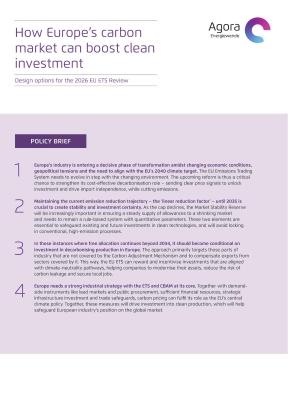
Publisher: Agora Energiewende
Date: July 2026
The EU Emissions Trading System is instrumental in driving cost-effective emission reductions. As Europe’s industry enters a decisive phase of decarbonisation, the system needs an upgrade – to align with Europe’s 2040 target and with changing economic and political conditions. The review should strengthen the role of the EU ETS to support decarbonisation investments, enhance competitiveness and reduce fossil dependence.
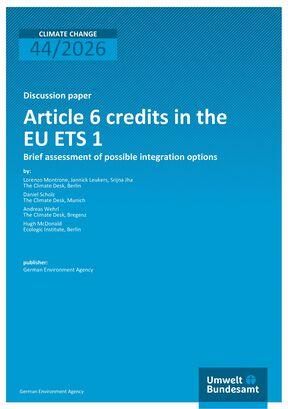
Publisher: German Environment Agency (Umweltbundesamt)
Date: July 2026
Following the amendment of the European Climate Law, the European Union (EU) may use a limited volume of Article 6 credits to meet its 2040 climate target. If a share of these credits enters the EU Emissions Trading System 1 (EU ETS 1), this paper argues that indirect integration through an intermediary mechanism would be preferable to direct use by regulated entities.
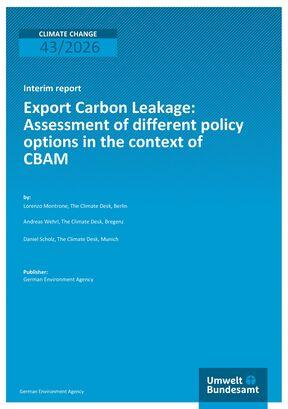
Publisher: German Environment Agency (Umweltbundesamt)
Date: July 2026
The Carbon Border Adjustment Mechanism (CBAM) levels carbon costs between EU and imported products but does not address export carbon leakage. As free allocation under the EU ETS is phased out, EU exporters face rising carbon costs, potentially reducing competitiveness in markets with weaker climate policies.
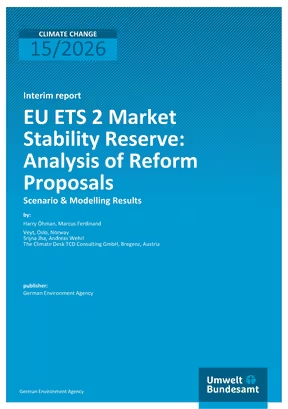
Publisher: German Environment Agency (Umweltbundesamt)
Date: March 2026
Currently, policymakers are debating the design of the Market Stability Reserve (MSR) in the EU Emissions Trading System 2 (EU ETS 2) and its role in smoothing allowance supply, limiting price increases, and safeguarding the system’s environmental integrity.
Publisher: German Environment Agency (Umweltbundesamt)
Date: November 2025
The CBAM scope includes selected imported goods to ensure a level playing field with EU production covered by the EU ETS 1. While 573 mainly basic materials and products are covered, expanding the scope to downstream goods must be assessed.
Publisher: Deutsche Gesellschaft für Internationale Zusammenarbeit (GIZ) GmbH
Date: February 2025
High-quality accounting of greenhouse gas (GHG) emissions is pivotal to achieving net-zero emissions targets. In recent years, the proliferation of carbon accounting frameworks has created opportunities and challenges for businesses, regulators, and stakeholders. This report provides a comprehensive overview of these carbon accounting frameworks in the EU and Germany, offering insights into their characteristics, applications, and opportunities for improvement.
Publisher: Deutsche Emissionshandelsstelle (DEHSt) at the Umweltbundesamt
Date: July 2025
This study analyses how Germany’s national emissions trading system and other policies shape the market for conventional biofuels made from food and feed crops. It tracks volumes, feedstocks and prices of key fuels such as biodiesel, HVO and bioethanol, and compares them with fossil fuels.
Publisher: German Chamber of Industry and Commerce (DIHK), German Association of Local Public Utilities (VKU)
Date: July 2025
This project provides an in-depth evaluation of the European Union’s proposed 2040 climate target, which aims for a 90% reduction in net greenhouse gas (GHG) emissions compared to 1990 levels.